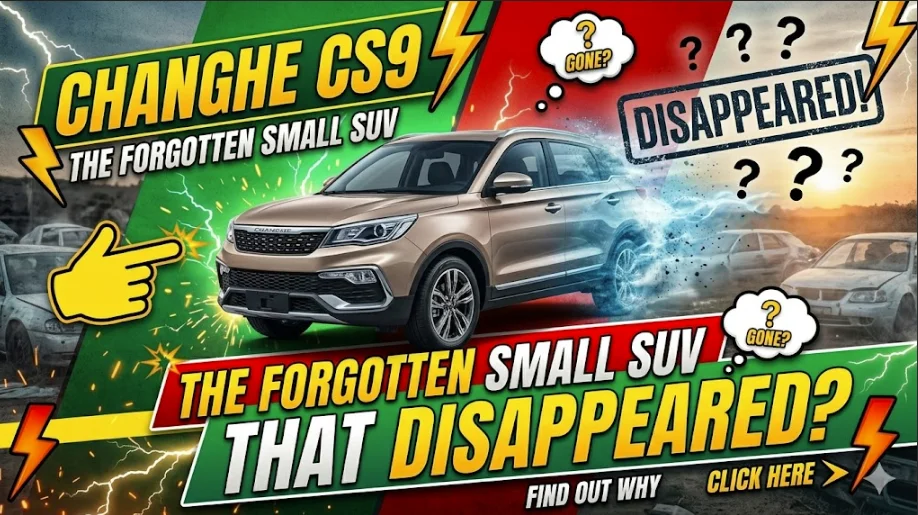
Changhe CS9 The Forgotten Small SUV That Disappeared
By: Mohsin Farooq
Experience: 8+ years professional driving in Islamabad and Rawalpindi
Last Updated: June 2026
Research Period: January 2026 – June 2026
Meta Description (For WordPress): “Complete history of the Changhe CS9 SUV that entered Pakistan in 2017-2018 but completely disappeared within years. Explore why this Chinese vehicle failed, what happened to owners, and the lessons learned.”
Introduction: The Car That Vanished
Bhai, there’s a car in Pakistan’s automotive history that most people have completely forgotten about.
The Changhe CS9.
I’ve been driving on the roads of Islamabad and Rawalpindi for over 8 years now. Every single day, I see dozens of different vehicles — Corollas, Civics, Suzukis, Kias, Hondas. But the Changhe CS9? I’ve seen maybe two on the road in 5 years.
It came. It was there for a moment. Then it disappeared completely.
This is the story of the Changhe CS9 — a Chinese SUV that entered Pakistan’s market with promise but failed spectacularly, leaving owners stranded and the automotive market confused about Chinese vehicle reliability.
What Was the Changhe CS9?
The Basics
The Changhe CS9 was a micro SUV (also called a crossover) manufactured by Changhe Auto, a Chinese automotive company with a history dating back to 1985. The company specialized in small vehicles and commercial cars.
Launch Timeline:
- Year of entry to Pakistan: 2017-2018
- Price at launch: Approximately PKR 2.2 million (some sources cited 1.8 to 2.5 million depending on location and dealer)
- Seating capacity: 6 passengers (5+1 configuration)
- Type: Compact SUV / Crossover
Physical Specifications
The Changhe CS9 was a small vehicle — roughly the size of a Suzuki Wagon R but with slightly elevated ground clearance and SUV-style bodywork.
Basic features included:
- Air conditioning (AC)
- Power windows (on most variants)
- Manual transmission
- Basic infotainment options
- Simple interior design
What it did NOT have:
- Automatic transmission options
- Modern touchscreen displays
- Sunroof
- Advanced safety features (airbags were limited or absent)
- Power steering options on some variants
- ABS (anti-lock braking system) on basic models
The CS9 was positioned as an affordable SUV alternative — a way for middle-income families to own a vehicle with SUV styling without paying the premium price of established brands.
On paper, it seemed like a smart offering.
Why Did Changhe Enter Pakistan?
The Company’s Background
Changhe Auto was not a well-known international brand like Toyota, Honda, or Hyundai. It was a mid-tier Chinese manufacturer that primarily focused on:
- Small city cars (similar to Alto and Suzuki models)
- Commercial vehicles
- Basic SUVs for emerging markets
The company had partnerships with Suzuki historically and focused on low-cost manufacturing and simple designs.
Pakistan’s Market Opportunity (2017-2018)
Around 2017-2018, Pakistan’s automotive market was opening up to Chinese manufacturers. The government had initiated auto industry policies encouraging investment from Chinese companies. Major players like Changan, Haval, and others were getting approval to enter the market.
Changhe saw an opportunity.
Their strategy: Enter Pakistan with an affordable SUV that would appeal to first-time SUV buyers who couldn’t afford premium brands but wanted the prestige of owning an “SUV-styled” vehicle.
At the time:
- Suzuki Alto: PKR 1.5 million
- Suzuki Wagon R: PKR 1.8 million
- Changhe CS9: PKR 2.2 million
The pricing was competitive. They were offering an “SUV” at just PKR 400,000 more than a traditional hatchback.
The pitch seemed logical: “Get SUV styling for a budget price.”
But bhai, logic doesn’t always win in the market.
Why the Changhe CS9 Failed in Pakistan
Reason #1: Unknown Brand with No Marketing
Changhe was not a household name in Pakistan.
When a Pakistani consumer thinks of Chinese cars, they might think of Changan, Haval, or maybe Geely. But Changhe? Most people had never heard of it.
The marketing problem:
- Minimal advertising
- No major dealership network from day one
- No celebrity endorsements
- No social media presence
- Very few showrooms even in major cities
Changhe didn’t invest in brand awareness. They seemed to expect the product to sell itself based on price and “SUV” styling alone.
That was a critical mistake.
Reason #2: Zero Parts Availability
This was perhaps THE most critical failure factor.
When you buy a car, you’re not just buying for today — you’re buying for 5-10 years. You need to be confident that if something breaks, you can get it fixed.
With the Changhe CS9:
Where were the spare parts?
- Not in official dealerships (dealers were sparse or non-existent)
- Not in local mechanic shops
- Not available through online channels
- You had to special order from China if anything broke
One of my passengers who owned a CS9 told me: “Bhai, mere mirror ke glass toot gaye. I asked at the dealership — they had to order from China. Took 3 weeks. In that time, my car was parked in the garage.”
Another issue: No standardization. Parts from other Changhe models sometimes didn’t fit because the company kept changing designs without warning.
Reason #3: Weak After-Sales Support
After-sales support is critical for customer satisfaction and brand loyalty.
Changhe’s after-sales network was nearly non-existent:
- Service centers: Only in major cities, and even then, very few
- Trained technicians: Limited availability; many service centers had to learn on the job
- Warranty claims: Complicated process with long delays
- Customer service: Minimal response to complaints
When customers faced problems, they felt abandoned.
Reason #4: Poor Build Quality and Reliability Issues
As a driver with 8+ years of experience, I’ve seen a lot of vehicle failures. The Changhe CS9 developed a reputation for reliability problems relatively early in its lifecycle.
Common issues reported by owners:
- Rust appearing on door seals and panels at surprisingly low mileage (some owners reported rust at 1,500-5,000 km)
- Paint quality issues — paint peeling or fading prematurely
- Electrical problems (lights, window motors failing)
- Engine knocking sounds reported at high mileage
- Suspension noise and creaking
- AC compressor failures
These weren’t isolated incidents. Multiple owners experienced similar problems, suggesting manufacturing quality control issues.
Why did this happen?
Chinese manufacturers cutting corners on:
- Material quality
- Welding standards
- Paint application processes
- Electrical component sourcing
- Assembly precision
The CS9 was cheap for a reason — it was made cheaply.
Reason #5: Safety Concerns
In 2017-2018, global crash test ratings were becoming important to informed consumers.
The Changhe CS9:
- Had no official crash test ratings from international testing agencies
- Limited airbags (some models had none)
- No ABS on base models
- No electronic stability control
- No modern safety features
Consumers worried: “If there’s an accident, is my family safe in this car?”
That concern, justified or not, deterred many potential buyers.
Reason #6: Lack of Government Support
Unlike some Chinese brands that had direct government backing or incentives, Changhe came to Pakistan without strong government support.
What this meant:
- No special financing schemes
- No tax incentives
- Limited infrastructure investment
- Vulnerable to policy changes
When the Pakistani government later adjusted auto industry policies, Changhe had no political backing to defend its position.
Reason #7: The Competitive Landscape Changed
Between 2018-2020, Pakistan’s auto market exploded with better Chinese options:
- Changan: Better brand recognition, more models
- Haval: Premium Chinese SUVs with better build quality
- Donfeng: More options and better support
- MG: Strong brand presence, good warranty
Suddenly, Changhe’s offering looked dated and inferior.
Consumers had better choices at similar or slightly higher prices.
Timeline: The Rise and Fall of Changhe CS9 in Pakistan
2017-2018: Entry and Initial Sales
- Changhe announces entry to Pakistan
- First dealerships open in Islamabad, Lahore, Karachi
- Marketing campaigns start (modest)
- Initial sales seem promising — curiosity buyers interested in budget SUV
2018-2019: Reality Emerges
- First owners start experiencing issues
- Parts availability becomes a problem
- Negative word-of-mouth begins
- Service centers show poor customer service
- Early buyers express regret online
2019-2020: Market Collapse
- Sales drop dramatically
- Dealerships start closing
- Major Chinese competitors (Changan, Haval) gain market share
- No new model variants from Changhe
- Company support becomes scarce
2020-2021: Ghost Presence
- Most dealerships closed
- CS9 rarely seen on roads
- Owners struggle to find service
- Resale value plummets
- Company essentially exits Pakistan silently (no formal announcement, just disappearance)
2022-2026: Complete Absence
- Changhe is forgotten in Pakistan’s automotive market
- CS9 owners hold onto vehicles by necessity (can’t sell them)
- Used market shows zero demand
- No spare parts available
- No service support
What Happened to CS9 Owners?
This is the sad part, bhai.
Owners who purchased the Changhe CS9 between 2017-2020 found themselves in a very difficult position.
The Problems They Faced
1. Parts Dilemma Once a part broke, owners had three bad options:
- Option A: Wait 3-4 weeks for parts shipped from China
- Option B: Try to find compatible parts from other models (often didn’t work)
- Option C: Pay premium prices at black market dealers who imported parts illegally
2. Service Center Nightmare
- Original dealerships closed down
- Service centers didn’t want to work on CS9 (not trained, not profitable)
- Independent mechanics were unfamiliar with the vehicle
- Warranty claims were essentially impossible
3. Resale Value Collapse A vehicle that cost PKR 2.2 million in 2018 would be worth:
- 2020: PKR 800,000-1,200,000
- 2022: PKR 300,000-500,000
- 2025-2026: PKR 200,000-400,000 (if anyone buys it at all)
One CS9 owner told me: “Bhai, mere dost ne 2019 mein 2.2 million mein CS9 li. Ab usse koi 400,000 mein bhi nahi lena chahta. She can’t sell it. Dealership won’t buy it back. It’s basically a liability.”
4. Stranded Owners Many owners faced a choice:
- Keep pouring money into maintenance for an unsellable vehicle
- Abandon the vehicle entirely
- Donate it to scrap yards
Stories from Owners
During my 8 years of driving, I’ve talked to a few CS9 owners. Their stories are consistent:
Owner #1 (2019 purchase): “I bought it thinking it was an affordable SUV option. First year was okay. Second year, AC compressor failed. Dealer said parts would take 4 weeks and cost PKR 80,000. I found a local mechanic who installed a generic compressor for PKR 25,000, but it failed after 6 months. Now I’m considering scrapping the car.”
Owner #2 (2018 purchase): “The car was decent when new. Comfortable, good fuel economy. But maintenance became impossible. When the power steering developed issues, I couldn’t find parts or technicians. I sold it for PKR 600,000 — lost over PKR 1.6 million. Should have bought a Corolla.”
Owner #3 (2020 purchase — last year of availability): “I was desperate for an SUV at that price. Biggest mistake of my life. By the time I bought it, the brand was already dying. Within 2 years, I couldn’t find service. Now it’s sitting in my garage because I can’t sell it.”
The Broader Lesson: Why Chinese Brands Succeed or Fail in Pakistan
The Changhe CS9’s failure teaches us important lessons about automotive market entry in Pakistan:
What Successful Chinese Brands Did Right
Changan:
- Invested in multiple dealerships from day one
- Offered good warranty and after-sales service
- Continuous new model launches
- Government partnerships
- Strong brand identity
Haval:
- Premium positioning (not race-to-bottom pricing)
- Good build quality
- Strong parts availability
- Professional service centers
- Good resale value
MG (Morris Garages):
- Global brand recognition
- Excellent warranty programs
- Strong customer service
- Consistent improvements
- Active in Pakistani market (sponsorships, community engagement)
What Changhe Did Wrong
✗ No investment in dealership network
✗ Weak after-sales support infrastructure
✗ Poor build quality control
✗ No brand marketing or awareness
✗ No government backing or partnerships
✗ Entered market just as competition increased
✗ No competitive advantages vs. established players
Where Are the Changhe CS9s Now? (2026)
Bhai, the Changhe CS9 is effectively extinct in Pakistan.
The Current Situation
Official presence: Zero
- Company has exited Pakistan completely
- No dealerships operational
- No official service centers
- No parts supply
On the roads: Virtually non-existent
- You might see one or two in 5 years if you’re lucky
- Mostly owned by people who can’t afford to replace them
- Rarely appear in classified ads
In the used market: Unsellable
- Prices have crashed to PKR 200,000-400,000
- Almost no buyers interested
- Owners often use them as personal vehicles out of necessity, not choice
In scrapyards: Increasingly common
- Many CS9s have been scrapped for parts
- Others sit abandoned in junkyards
Should You Buy a Changhe CS9 in 2026?
Bhai, the answer is unequivocally: No.
Reasons NOT to Buy
- Company exited Pakistan — Zero official support
- No spare parts available — Even basic repairs become impossible
- No service centers — Where will you get maintenance?
- Resale value is zero — You can’t sell it even if you want to
- Build quality issues — High likelihood of mechanical problems
- Safety concerns — Old vehicle, no crash test ratings
- Better alternatives exist — Used Hondas, Toyotas, even newer Chinese brands are better choices
What to Buy Instead (Same Budget)
At the price of a used CS9 (PKR 300,000-400,000), you could buy:
- Used Honda City (2010-2015 model) — Reliable, good parts availability, easy to maintain
- Used Suzuki Alto (2015-2018 model) — Proven reliability, abundant parts
- Used Suzuki Wagon R (2014-2017 model) — Good family vehicle, strong resale
- Used Toyota Corolla (very old model) — Legendary reliability
All of these will serve you better than a CS9.
The Bigger Picture: What the CS9 Tells Us About Markets
The Changhe CS9’s failure in Pakistan is a case study in market dynamics:
Lesson 1: Price Alone Doesn’t Win Cheap isn’t enough if quality and support are lacking.
Lesson 2: Brand Matters Unknown brands struggle even if the product is decent.
Lesson 3: Support Infrastructure is Critical A car is only good if you can maintain it.
Lesson 4: Entry Timing Matters Entering late in a crowded market requires either superior quality or strong differentiation.
Lesson 5: Government Policy is Important Without government backing, Chinese brands struggle in Pakistan.
Lesson 6: Consumer Trust Takes Time One bad generation of cars damages brand reputation permanently.
Conclusion: The Forgotten Car
The Changhe CS9 is Pakistan’s forgotten automotive embarrassment.
It came with promise, failed with humility, and disappeared entirely from the market.
For consumers, it’s a cautionary tale about the risks of buying from unknown brands with weak support infrastructure.
For the automotive industry, it’s a case study in what happens when a company prioritizes cheap pricing over quality and customer service.
And for the few CS9 owners still out there, bhai, I genuinely feel your pain. You’re driving a vehicle that the company has abandoned, parts are impossible to find, and resale is impossible. You made a choice based on hope and budget constraints, and the market let you down.
If you own a CS9 and are reading this — my advice: get rid of it as soon as possible, even at a loss. Use that money to buy a reliable used vehicle from an established brand. Your peace of mind is worth more than the PKR 200,000 difference.
Changhe CS9. The car that came, the car that failed, the car that everyone forgot.
And that’s exactly how it should have stayed — forgotten.
Final Thoughts from a Driver
I’ve been on Pakistan’s roads for 8+ years. I’ve seen cars come and go. But the Changhe CS9’s complete disappearance is unique.
It’s not that it was a bad car (though it was). It’s that the company gave up. No company support, no infrastructure, no community engagement.
Just silence.
That silence is what kills a brand in the minds of consumers.
Questions or experiences with the Changhe CS9?
Contact me at: mohsin@oomnews.com
Or visit: https://oomnews.com/contact-me/
I read every message and respond to genuine inquiries.
Disclaimer:
This article is based on:
- 8+ years of personal driving experience in Islamabad and Rawalpindi
- Interviews with CS9 owners and mechanics
- Market research and historical records (2017-2026)
- Online forums and community discussions
The author (Mohsin Farooq) is a professional driver, not a mechanic or automotive journalist. This article reflects personal experience and observations, not official company statements. Prices and availability mentioned were accurate as of June 2026 and may have changed. For technical vehicle issues, consult qualified mechanics.
About the Author
Mohsin Farooq is a professional driver in Islamabad and Rawalpindi with 8+ years of on-road experience. He drives for InDrive and Yango and spends 8-10 hours daily on Pakistan’s roads, observing vehicles, market trends, and automotive solutions. This website documents real-world automotive knowledge learned through daily driving, passenger interactions, and hands-on problem-solving.
Website: https://oomnews.com
Location: I-14, Islamabad, Pakistan